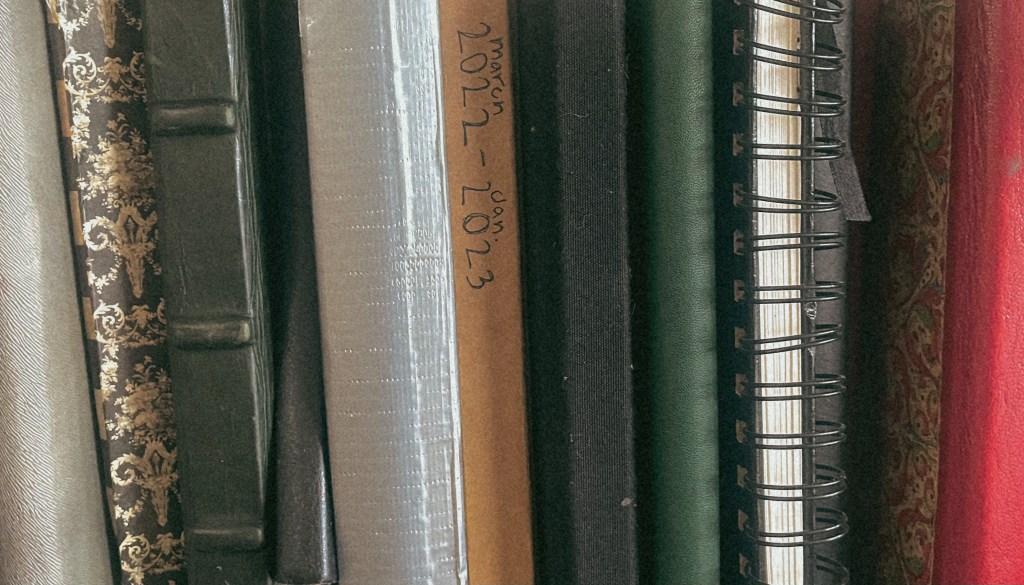
I have encountered many people over the years who mention the practice of journaling in some form of the comment, “I’ve always wanted to start, but I can never keep up with it.” Or my favorite, “I have so much to say in my head, but I wouldn’t know how to write it down.” These phrases are problematic because they establish a perceived failure before you’ve even picked up a pen.
My response to these concerns is always a challenge. “You don’t have to ‘keep up’ with it. Sometimes I write multiple times a day, and sometimes it’s months between entries. The point is not measurable consistency, it’s using the journal as a tool when you need it.” And in response to the head-full/page-empty comment, “It’s not about perfection. In fact, part of the value is letting go of perfection. Allow the words to flow through you for a bit, and don’t read them back until you’ve gotten comfortable with the process.”
These conversations have made it clear that there’s one main culprit keeping people away from their pens: fear. As a culture, we have cultivated a dynamic of radical self-love pitted against an intense fear of self-intimacy within the individual. It’s total focus on the self rather than total focus within the self. So, let’s spend a little time extinguishing our fear of what we’ll find within. Here are some things I’ve learned over the past 14 years of journaling.
1. The Journal Matters
This is the most materialistic of my tips, so I’ll get it out of the way first. Above all, write on what’s accessible for you. My journals contain pages of taped-in notecards and napkins, all scribbled in the marginal minutes. Slow nights at work, waiting to board a plane – these moments, memorialized, show you more about yourself than you might expect. If you have the means, however, I would suggest a journal small enough to carry with you. I tend to like mine book-sized, unlined, with a medium-hardcover, which brings me to the next point.
Invest in the journal that’s most comfortable for you. Consider line spacing, paper texture, the way it’s bound, how well it fits into your favorite bag. In my experience, creating a physically comfortable space in which to journal helps you write more openly from the get-go. It doesn’t matter if you’re into motivational quotes or handmade, leatherbound notebooks; rather than trying to fit an aesthetic, go with what feels most like you.
2. Forget Format
Dear Diary,
Please don’t write a letter to your journal every day unless you’re absolutely stoked to do so.
Sincerely, Siena
Seriously though, you don’t have to write a book. In 2016 I filled an entire journal with nothing but disjointed bullet-point-poems. After I read the Bell Jar in 2019, I wrote like Sylvia Plath for about eighty pages until spring bloomed and my depression fell away. My sister’s journals used to catalog her stuffed animal collection, complete with names and color classifications. Now they’re filled with construction schematics for van builds and Earthships (she’s a cool gal). Though they’re not in traditional diary format, they tell her story just as well. The point is to fill the pages in a way that’s authentic to you. A ten-page rant is just as valid as a prayer, which is just as valid as a comic-book illustration of your day at work. The format doesn’t matter as long as you’re creating from a place of truth.
3. Authenticity
I recently listened to a Ted Talk in which the person speaking claimed that the state of consciousness which produces the highest vibrational energy is not love or gratitude, but authenticity. While the intrinsic worth of journaling is different for everyone, I enjoy it most as a mindfulness practice. Your journal is a safe space for you to discover yourself, so write from a place of truth and humility. There is no audience, so there is no need for affect. Observe the sentences in which you are trying to form an identity and consider their authenticity. When I was younger, I described myself in the same way Young Adult authors describe their angsty protagonists. These self-characterizations were only half true, and in failing to observe them with attempted objectivity, I was robbing myself of potential growth. Your journal is not the space to construct a self-image that makes you feel good, we have social media for that. It’s a space to understand, and come to love, the parts of yourself you don’t know as well.
4. Forget the Perfectionism
This point is woven through the aforementioned tips, but it’s worth its own feature. Don’t write for an audience, even if that audience is yourself. Write to evolve. Write to process and to understand. Write to create. Write to remember. But don’t do it for anyone else. The moment you invite external perception into your safe space is the moment it is no longer sacred. That said, your journal is an exceptional resource for creative projects. I use insights from mine all the time in my writing. Journaling for an audience is a less authentic intention than seeking inspiration from your journals to create for an audience. You need the freedom to fuck up on the page without consequence, and while I know you’re not writing your open mic poetry set after three martinis, you might write something you didn’t expect, and this something could be the foundation of your set. That’s how it works. Art is so beautiful when it comes from an organic place.
So, write when you feel the smallest urge, or when you can’t make sense of the clutter in your brain. It’s valid and natural to go through ebbs and flows in this process, and it’s okay to put your journal down if it isn’t serving you in the moment. The important thing is that you pick it back up when you feel the pull rather than ignoring the impulse.
I hope at least one of these tips makes journaling a bit more accessible. There is so much growth encapsulated [and ongoing] in my journal pages, and I’m grateful for the space to share such a meaningful thing.
Happy journaling ❤
Siena
 Presently
Such a lifetime of great wisdom here! Next journal’s on me!😘
LikeLiked by 1 person